 12-Day Best of Italy
 The White Lotus Experience
 Southern Thrills
 Tuscan Coastal Escape
 E-Bike Holiday in Tuscany
 Tuscany
 Sicily
 Amalfi Coast & Naples
 Puglia & Calabria
 Dolomites, Verona & Venice
 Italian Lakes
 Umbria
 Cinque Terre
 Food & wine
 Honeymoons & romance
 First trip to Italy
 Family & multigenerational
 Luxury private tours
 Private groups
 Day experiences
 Private, group or DIY?
 Driving in Italy
Quick answer: Rome vs Florence comes down to scale. Rome, a capital of about 2.75 million, needs three or four nights for its ancient sites and the Vatican. Florence, a city of under 400,000, fits its Renaissance highlights into two or three nights on foot. On a first trip do both: they are about 1.5 hours apart by train.
| Factor | Rome | Florence |
|---|---|---|
| Size | About 2.75 million residents, sights spread across districts | Under 400,000 residents, compact walkable centre |
| UNESCO listing | Historic Centre inscribed 1980 | Historic Centre inscribed 1982 |
| Headline sights | Colosseum, Forum, Vatican Museums, St Peter's, Pantheon, Borghese | Duomo and dome, Uffizi, Accademia (David), Pitti and Boboli |
| Most visited site (2024) | Colosseum park, 14,733,395 visitors | Uffizi Galleries, more than 5 million |
| Suggested nights | 3 to 5 | 2 to 4 |
| Getting around | Metro, bus, driver; walking within each district | Mostly on foot; bus and tram |
| Single transport ticket | €1.50, valid 100 minutes | €2.00, valid 90 minutes; under-11s free |
| Museum closures | Vatican Museums closed on Sundays except the last of the month | Uffizi and Accademia closed on Mondays |
| Best for | Ancient history, pilgrims, big-city energy | Renaissance art, food and wine, Tuscany day trips |
Is Rome or Florence better for a first trip to Italy?
For most first trips the honest answer is both, with more nights in Rome. Rome needs a day for the Colosseum and Forum and another for the Vatican, while Florence’s main sights fit into two full days on foot. The two cities are about 1.5 hours apart by high-speed train, so pairing them costs very little time.
The scale is the real difference. In 2024 the Colosseum archaeological park was Italy’s most visited state site, with 14,733,395 visitors. The Uffizi Galleries in Florence came second, with more than 5 million. Both historic centres are UNESCO World Heritage Sites: Rome’s since 1980 and Florence’s since 1982.
If you can only choose one city, this is how we would decide:
- Choose Rome if ancient history, the Vatican and the energy of a capital are why you are going. Our guide to Rome attractions and what to see first lists the sights worth your first days.
- Choose Florence if Renaissance art, a centre you can cross on foot and easy day trips into Tuscany matter more. Read about Florence’s Renaissance buildings before you go.
For a broader look at routes that start with these two cities, see our page on planning a first trip to Italy.
How do Rome and Florence compare in size and pace?
Rome is a capital of about 2.75 million residents spread over a wide area, with sights in several separate districts. Florence is a city of under 400,000, and its historic centre is compact enough to walk end to end. Rome rewards a slower pace over more days; Florence rewards early starts and booked time slots.
A few contrasts that shape a day on the ground:
- Getting across town. In Rome you will use the metro, buses or a driver to link the Vatican, the Colosseum and Trastevere. Metro C now stops at Colosseo/Fori Imperiali, which opened in December 2025. In Florence most travellers walk everywhere inside the centre.
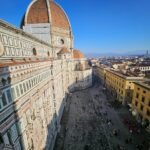
- Climbing the domes. Brunelleschi’s dome in Florence, built 1420 to 1436, has 463 steps to the top and no lift. St Peter’s dome in Rome has about 551 steps, or about 320 if you take the lift that covers the first part.
- Vehicles in the centre. Since October 2025 Florence has banned golf carts, tuk-tuks and rickshaws for tourists in its UNESCO area. Rome has also moved to limit golf-buggy tours, with details still emerging.
- Summer heat. Both cities average highs around 89°F in July and August, so plan sightseeing for the morning in either.
Which city should get more nights, by type of traveller?
Give Rome more nights if your list leans ancient, Catholic or big-city. Give Florence more if you care most about Renaissance art, food and wine, or a compact base for Tuscany. Families and travellers who walk less can lean either way, depending on stairs and distances. Here is how we usually split a week between the two.
| Traveller | Rome nights | Florence nights | Why |
|---|---|---|---|
| First-timers | 4 | 3 | Rome’s headline sights need three full days, Florence’s two |
| Art and architecture lovers | 3 | 4 | Uffizi, Accademia, Duomo, Pitti and the Bargello deserve unhurried visits |
| Ancient history fans | 5 | 2 | Colosseum, Forum, Palatine, Galleria Borghese and the Vatican |
| Catholic pilgrims | 5 | 2 | St Peter’s, the Vatican Museums and the papal basilicas |
| Food and wine travellers | 3 | 4 | Florence is the gateway to Chianti and the wider Tuscan countryside |
| Families with children | 3 | 4 | A walkable centre, free buses for under-11s and short museum visits |
A few nuances
Pilgrims should look at our page on a Catholic pilgrimage to Italy, which covers papal audiences and the basilicas in detail. Food and wine travellers often add nights in the countryside rather than in Florence itself; our private Tuscany tours show how that works with a driver.
For travellers who find stairs hard, Rome has an edge at one key site: the Colosseum has a lift between its first and second tiers. Florence’s dome climb has no lift at all, and the Spanish Steps in Rome are about 135 steps, so we plan routes around both.
Rome or Florence for 3 days: which should you pick?
With three days, pick Florence if you want to see most of what you came for without rushing. Pick Rome if the Colosseum and the Vatican are the reason for the trip. Three days in Rome covers the headline sights but leaves whole neighbourhoods for next time; three in Florence leaves room for a day out in Tuscany.
Three days in Rome
- Ancient Rome. Colosseum, Forum and Palatine on a timed slot. Official tickets open 30 days before your visit on ticketing.colosseo.it.
- The Vatican. Vatican Museums, the Sistine Chapel and St Peter’s. The museums open Monday to Saturday and on the last Sunday of the month, when entry is free; buy only on tickets.museivaticani.va.
- The centre. The Pantheon (€7 since July 2026), the Trevi Fountain (€2 for the close-up area since February 2026) and the Galleria Borghese, where booking is compulsory and tickets go on sale 10 days ahead.
Three days in Florence
- Duomo and David. The Brunelleschi Pass is the only ticket with the dome climb, and its time slot cannot be changed. The Accademia, home of David, costs €20.
- Uffizi and Oltrarno. The Uffizi is €25 on the day or €29 booked ahead, and tickets carry your name. Cross the Arno for Palazzo Pitti and the Boboli Gardens.
- Tuscany. Chianti or Siena with a private driver, or a slower day in the Bargello on the €26 combined Accademia and Bargello ticket.
One rule for both lists: the Uffizi and the Accademia close on Mondays, so never put Florence’s museum day on a Monday.
How do you split a stay between Rome and Florence?
A simple split is three nights in Rome and two in Florence for a five-night trip, or four and three for a week. Florence has no US nonstops as of late 2026 schedules, so most travellers fly into Rome and continue to Florence by train.
| Nights available | Rome | Florence | Add-on |
|---|---|---|---|
| 5 | 3 | 2 | None; keep it to the two cities |
| 7 | 4 | 3 | One Tuscany day from Florence |
| 10 | 4 | 3 | Three nights in the Tuscan or Umbrian countryside |
| 12 or more | 3 to 4 | 2 to 3 | Add Venice and the Amalfi Coast |
The 12-night pattern is close to our 12-day Best of Italy itinerary, which links Amalfi, Rome, Florence and Venice.
The transfer day
The train takes about 1.5 hours on either Trenitalia or Italo, with more than 30 Frecciarossa trains a day. Some Italo trains use Roma Tiburtina rather than Termini, so check your ticket. Trenitalia high-speed fares are reported to be demand-based since January 2026, so booking early tends to cost less.
The alternative is a private driver, which turns the transfer into a sightseeing day with a stop in Orvieto or an Umbrian hill town on the way. We compare the two in private driver or train in Italy.
Is Rome or Florence more expensive to visit?
Hotel rates in both cities follow demand, so compare the fixed charges instead. Rome’s city tax is higher at the top end, reported at €10 per person per night in 5-star hotels and €7.50 in 4-star, for up to 10 nights. Florence’s reported rates are €8 and €7, for up to 7 nights, with under-12s exempt.
These are 2026 rates, and the 2027 rates are not yet confirmed. Hotels add the tax to your bill on arrival or departure.
- Public transport. A Rome BIT ticket is €1.50 for 100 minutes, and a 24-hour ticket is €8.50. A Florence bus and tram ticket is €2.00 for 90 minutes, and children under 11 ride free.
- City cards. The Roma Pass runs for 48 or 72 hours and includes public transport plus one or two sites. The Firenzecard is a 72-hour museum card that starts at your first museum entry.
- Driving. Both historic centres are limited traffic zones, and in Florence the whole centre is one. Cameras record plates, and fines reach rental drivers months later. Read our guide to ZTL zones and driving in Italy before you hire a car.
The biggest cost lever is how many nights you spend in each city, because the hotel bill and the city tax both grow with every night.
How does a private trip handle Rome and Florence?
A private trip removes the parts that cost time: ticket windows, the transfer day and finding the right guide. Our team lives in Italy, in Tuscany, Florence, Umbria and Rome, and plans each trip around your dates. We book timed entries, arrange drivers and local guides, and choose hotels in each city.
Every trip includes private drivers, local guides, selected hotels, entrance tickets, a day-by-day itinerary and a 24/7 WhatsApp concierge while you travel. Flights are not included, but we advise on routing and timing, including which airport to fly into.
If Florence is your priority, our 8-day Florence, Tuscany and Cinque Terre itinerary is a good starting point that we can extend with nights in Rome. There are no fixed packages; each trip is quoted individually.
Call our US line on +1 888-342-2847, message us on WhatsApp at +39 352 205 7020, or tell us your dates and request a personalised quote.
Frequently asked questions
Should I visit Rome or Florence first?
Start in Rome if you fly in from the US, because Rome Fiumicino has nonstops from US cities such as Miami and Chicago, while Florence has none as of late 2026 schedules. Rome also eases you in with big outdoor sights. Reverse the order if your Florence days would fall on a Monday, when the Uffizi and the Accademia are closed, or if you are flying home from Florence or Pisa.
Is Rome or Florence better with kids?
Florence is usually easier with young children. The centre is compact, buses and trams are free for under-11s, and Florence’s city tax exempts children under 12. The 463-step dome climb has no lift, so save it for older children with energy to spare. Rome works well for older children who love gladiators and ancient ruins, as long as days are kept short.
Is Rome or Florence better in December?
Rome has more on in December. By tradition the Pope pays homage at the Immaculate statue near the Spanish Steps on 8 December, and the Urbi et Orbi blessing is traditionally given in St Peter’s Square at noon on Christmas Day. Florence is quieter, with a Christmas market in Piazza Santa Croce that typically runs from mid-November to just before Christmas. Rome has about 9 hours of daylight around 21 December.
Can you see Florence in 2 days?
Yes, if you book ahead. Spend one day on the Duomo and its dome climb plus the Accademia, and the second on the Uffizi and Palazzo Pitti across the Arno. Book the dome, the Accademia and the Uffizi on their official sites, because the dome slot is fixed at purchase. Avoid a Monday, when the Uffizi and the Accademia close. A third day adds Tuscany.
Is Rome bigger than Florence?
Much bigger. The city of Rome has about 2.75 million residents, and the wider Rome province more than 4.2 million. Florence is a city of under 400,000, with about 989,000 in its metropolitan area. In practice this means Rome’s sights are spread across several districts linked by metro, bus or driver, while Florence’s main sights sit within walking distance of each other.
How much is the city tax in Rome?
Rome’s city tax depends on the hotel category. Reported 2026 rates are €10 per person per night in 5-star hotels and €7.50 in 4-star hotels, with lower rates for simpler places, and the overall range runs from €3 to €10. It applies to a maximum of 10 consecutive nights per property and is paid at the hotel. The 2027 rates are not yet confirmed.
Is it easy to walk around Florence?
Yes. Florence’s historic centre is compact, and the Duomo, the Accademia, the Uffizi and the Ponte Vecchio are a short walk apart. Since October 2025 golf carts, tuk-tuks and rickshaws for tourists are banned in the UNESCO area, so walking is the main way to see it. Expect stone paving and crowds near the Duomo, and save the dome climb for a fresh morning.
Planning a trip? Tell us your dates and what you love, call our US office on +1 888-342-2847 or message us on WhatsApp.